
Project
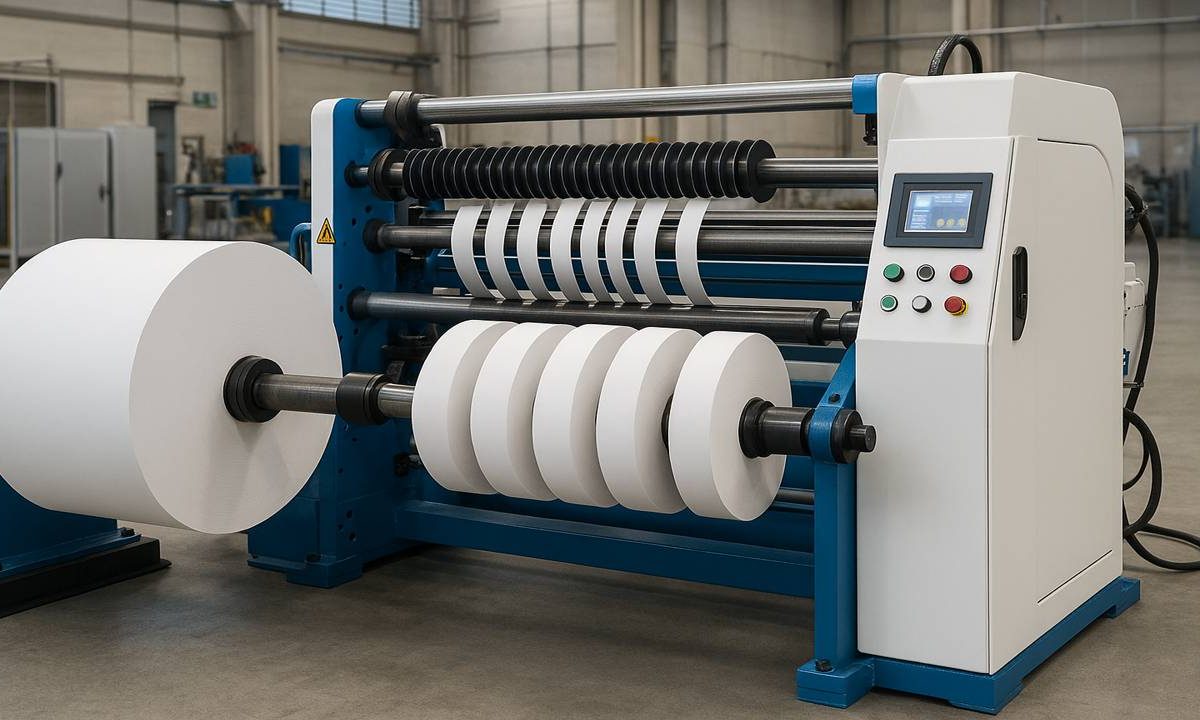
Revamping Machine Cutting and Ribboning Paper (Slitter Rewinder)
For a company in the paper district of Lucca (Tuscany), Emmetitech carried out an intervention by revamping on a longitudinal coil cutting machine (Slitter Rewinder) for the processing of paper and paperboard. The project, conducted with an integrated approach, concerned the mechanical, electrical and software upgrade of the machine, with the aim of improving precision, productivity and safety while extending the operating life cycle.
Production requirements and technical challenge
The machine was used for the transformation of mother coils into daughter coils ready for converting stages. Over time, critical issues typical of dated machinery had emerged: traction instability, uneven cutting edges, little compact coils and difficult to use in subsequent machining. In addition, the electrical panel was obsolete, lacking diagnostics and not prepared for data collection.
The main objectives of the customer were clear: to bring the machinery back to adequate performance levels, reduce waste, increase business continuity and ensure regulatory compliance.
Role of Slitter Rewinder in converting
The Slitter Rewinder is a central machine in converting paper: it divides the mother coil into smaller daughter coils, ready for printing, rolling or other industrial processing. Cutting precision, traction stability and winding regularity determine the quality of the next steps.
For a broader framework on longitudinal cutting technologies, seeRead more Longitudinal cutting machines in coil (Slitting), which describes principles and differences between Slitter Rewinder for flexible materials and Slitting Line for metal coils.
Solution
Emmetitech’s intervention included a complete revamping of the Slitter Rewinder, intervening in several areas. In particular:
- Mechanical part: revision of the winding group, recalibration of the lay-on roll, replacement of reducers and knife holders, updated with more precise adjustments to ensure a regular edge even at high speeds.
- Automation: Installation of a Siemens S7-1500 PLC and HMI Comfort Panel for recipes management and diagnostics; Siemens S210 servo drives for dynamic traction control and synchronisation of main movements.
- Security: Complete adaptation according to EN ISO 13849 and CEI EN 60204, with photoelectric barriers, interlocked shelters and area scanners.
These interventions have transformed an obsolete machine into an updated, reliable and fully compliant with modern standards.
Operating path
To make intervention effective and minimise the impact on production, the project has been structured in several stages.
The following table summarises the main steps, from preliminary analyses to final testing:
| Phase | Main activities | Operational notes |
|---|---|---|
| Preliminary analysis | Onsite reliefs, mechanical and electrical status assessment, priority definition | Paper District of Lucca |
| Design | Study solutions of upgrade, electrical panel design, layout modifications | Optimization for insertion into existing department |
| Automation & Software | PLC-HMI logical development, simulation recipes and tests in the workshop | Validation with real formats |
| Mechanical upgrade | Revision of traction components, replacement of knives and reducers, recalibration winding | Improved coil stability |
| Installation and testing | Site assembly, electrical connections, process tests and training operators | Planned work to reduce production stops |
This sequence made it possible to complete the intervention by minimising the impact on production and ensuring rapid start-up.
Technical focus
The heart of the intervention concerned traction control and edge quality. With the introduction of closed-circuit logic, supported by load cells and servodrives, the machine now keeps the voltage of the material constant throughout the process.
The replacement of circular knives and the recalibration of knives has improved the regularity of cutting, eliminating defects that compromised converting. On the automation side, the new HMI interface allows operators to manage the machine with predefined recipes and advanced diagnostics, reducing setup times and increasing repeatability.
The combination of new advanced mechanical and logical components has made the machine more stable even in variable working conditions.
Impact on the production process
Thanks to the revamping, the Slitter Rewinder has achieved significantly higher performance: increased operational speed, reduction of waste, improved process continuity and security adapted to current standards. Data collection also enables integration with company monitoring systems and preventive maintenance plans.
Project value for the customer
The project has demonstrated the effectiveness of revamping as a strategic choice: with a targeted investment, the customer has maintained a well-known and reliable machine, updated to modern standards and ready to guarantee productive continuity.
Moreover, revamping has allowed to avoid the burden of a higher investment for a new machine, reducing downtime and replacement costs. In the competitive context of the Lucca Paper District, the Slitter Rewinder is a refurbished production asset that is able to ensure consistent quality, efficiency and reliability over the long term.

