News
Longitudinal cutting machines in coil (Slitting)
The longitudinal cutting machines in coils are key elements for modern manufacturing. They transform the mother coils into reduced and uniform formats, ready for printing, converting or direct use in production lines. Without these technologies, sectors such as paper, packaging, technical textiles and steel would not have available semi-finished products with precise dimensions, constant quality and repeatability guaranteed.
Slitting definition and principle of operation
Slitting consists of the longitudinal cut of the mother coil along the feed axis. The material is made, divided into several parallel strips and rewinded into coils or smaller coils.
Depending on the type of material, the machines are divided into two families:
- Slitter Rewinder, dedicated to flexible supports;
- Slitting Line, designed for metals.
Operational logic is common, but technical solutions vary according to strength, thickness and elasticity.
Slitter Rewinder: flexible materials
The Slitter Rewinder works paper, cardboard, plastic films, nonwoven fabrics and technical tapes. It is not limited to cutting, but manages the material throughout the process.
Voltage control is the most delicate parameter: a mistake causes deformations in plastic films or tears in nonwavens. The precision of the edge is also critical, as any irregularities compromise the subsequent stages of printing, rolling or packaging. The winding must finally ensure compact and stable coils, suitable for Converting operations.
Modern machines use independent motors, electronic adjustments and digital interfaces, operating at high speed with constant quality. A concrete example is the Revamping of a paper cutting and rewinding machine (Slitter Rewinder), which demonstrates how the technological update allows to recover efficiency and production continuity.
Slitting Line: metal coils
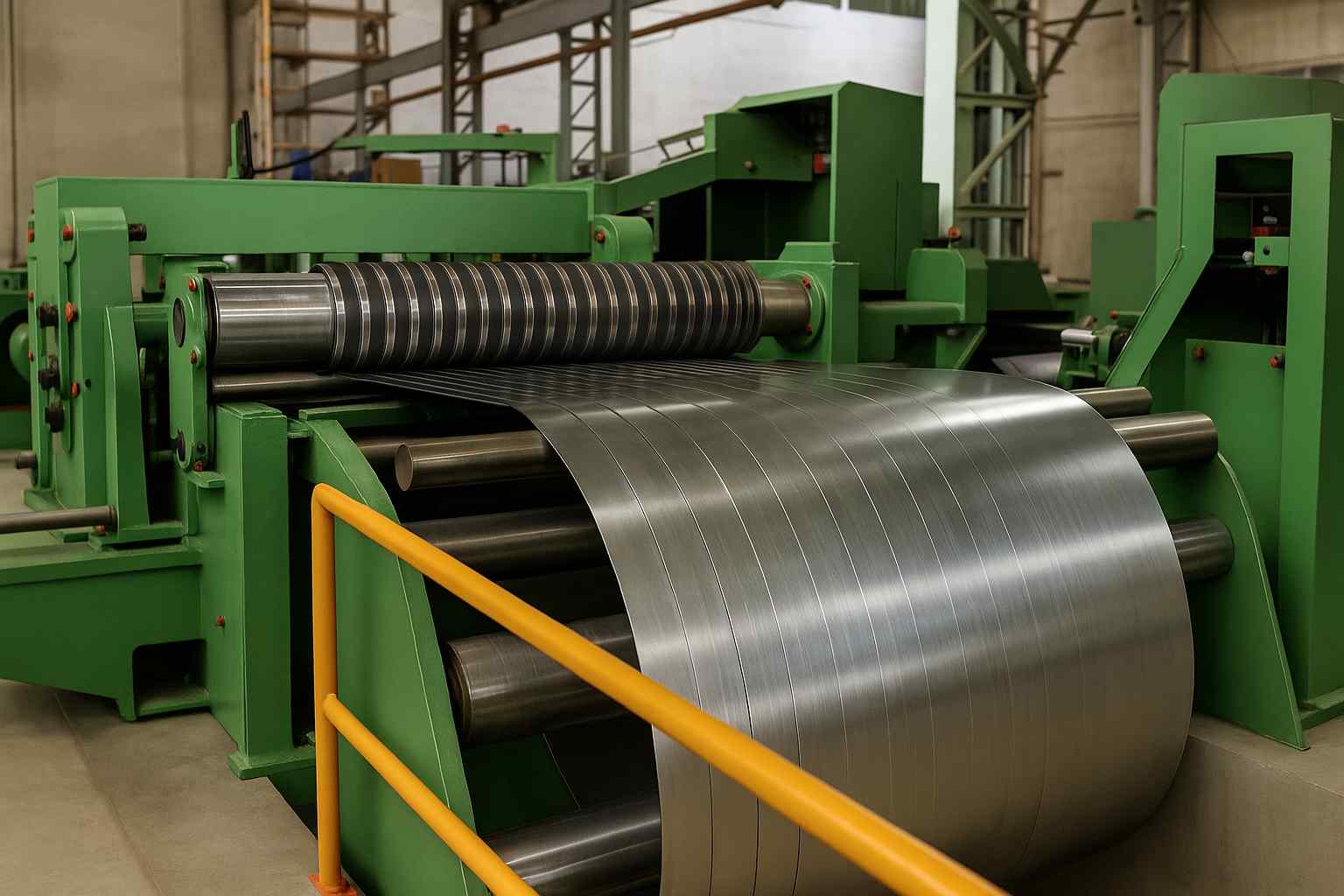
The Slitting Line is dedicated to the longitudinal cutting of steel, aluminium and copper coils. These are rigid materials, with high thicknesses and coils that reach tons of weight.
The cutting is done by means of hardened steel disc knives, which ensure precision and durability even in harsh conditions. The strips are then rewinded into new coils by recoiling, which must ensure compactness and stability.
These lines are applied in steel, automotive, construction and metal packaging. A representative case is the construction of a Slitting Line for sheet metal rolling and cutting, developed with Smart EPC approach and integrated into existing production processes.
Main differences
| Appearance | Slitter Rewinder (flexible) | Slitting Line |
|---|---|---|
| Materials | Paper, plastic films, nonwovens, tapes | Steel, aluminium, copper coils |
| Critical parameter | Winding voltage and quality | Mechanical power and precision |
| Cutting system | Circular blades (shear, score, crush) | Disc knives with spacers |
| Applications | Printing, packaging, medical, textile | Steel, automotive, construction |
Components and process parameters
Each machine consists of one reel, which supports the mother coil and regulates its progress, from acutting units, which divides the material, and by a retractor, which collects the final strips. Auxiliary systems complete the structure with driving functions, voltage control, waste management and specific devices such as separators or antistatics.
The final quality depends on critical variables: machining speed, cutting accuracy, tension stability and winding uniformity. In the flexible materials setup errors cause rubbing or telespair, in the metals they generate beams or disalignments. Only consistent adjustment and repeatable controls ensure consistent quality and reduction of waste.
Automation and control systems
Modern machines are no longer simple mechanical systems. PLC, inverter and servo-drives coordinate movements and voltage; HMI interfaces and SCADA systems allow the operator to monitor and intervene in real time.
Advanced functions such as automatic positioning of knives, rapid change of souls and digital recipes reduce setup times. Security is guaranteed by redundant sensors, barriers and logic, while integration with digital systems enables data traceability and predictive maintenance.
Benefits and strategic role
Slitter Rewinder and Slitting Line offer high productivity, waste reduction, consistent quality and operational flexibility. Digital integration also allows you to reduce machine stops, improve plant availability and optimize sustainability.
These technologies are not only cutting systems, but real strategic assets for industrial competitiveness. Whether it's new installations or revamping interventions, they remain a pillar of modern manufacturing, ensuring efficiency, continuity and reliability.